Showing posts with label mitsubishi. Show all posts

Friday, May 20, 2011

Nissan and Mitsubishi Motors sign contract for establishment of joint venture for minicar business


YOKOHAMA/TOKYO : May 20, 2011 - Nissan Motor Co., Ltd. and Mitsubishi Motors Corporation today announced that the two companies signed a contract for the establishment of a joint venture related to their minicar business in the Japanese market. The establishment of the joint venture was part of an agreement signed in December 2010 to expand the scope of cooperation between the two companies. The two companies will strengthen their competitiveness in the minicar business through this joint venture.


[Outline of New Joint Venture]
  • Date contract agreement : May 19, 2011
  • Date of establishment : June 1, 2011 (Planned date)
  • Capital : 10 million yen
Capital structure:
  • Nissan Motor Co., Ltd. : 50%
  • Mitsubishi Motors Corporation : 50%
  • Business description : Product planning and engineering of minicars for the Japanese market
Main board members:
  • CEO (Chief Executive Officer): Junichi Endo
  • COO (Chief Operating Officer): Shinichi Kurihara
[Source : NISSAN, MITSUBISHI]

Thursday, May 19, 2011

2012 Mitsubishi Eclipse SE

2012-Mitsubishi-Eclipse-SE-Front-Angle-ViewMitsubishi Motors has introduced one of their cars that became the model year 2012, the Mitsubishi Eclipse SE. This car is available in two models, which is cut and Spyder will enliven the auto market later. Mitsubishi Eclipse 2012 SE offers HID lamps, side "SE " scaling, black side mirror of 18 matte black alloy wheels. All variants come with a huge list of standard premium features that can find this on 2012 Mitsubishi Eclipse SE.

2012-Mitsubishi-Eclipse-SE-Side-and-Front-View2012 Mitsubishi Eclipse khusu edition comes in a unique and eye-catching display outside elements, including special side scaling.

2012-Mitsubishi-Eclipse-SE-Side-Angle-ViewIncluded amenities on the amply-equipped Eclipse GS-Sport models are a 4-speed automatic transmission, leather seating with heated front seats and a power driver’s seat, rearview camera, Bluetooth® hands-free phone access, HID headlights with fog lamps, heated side mirrors and an exquisite sounding 9 speaker, 650-watt Rockford Fosgate® premium audio system with SIRIUS® satellite radio. The coupe version of the Eclipse GS-Sport includes a sunroof as well.

2012-Mitsubishi-Eclipse-SE-Front-ViewStandard safety tools on all Eclipse models includes four-wheel disc anti-lock brakes (ABS) with Digital Brake-force Distribution (EBD); Energetic Stability Control (ASC) and Traction Control Logic (TCL); and advanced dual front air bag supplemental restraint system (SRS) and side air bags. Side curtain air bags are included on the Eclipse Coupe.

2012-Mitsubishi-Eclipse-SE-Rear-ViewPowering all of these aforementioned Eclipse Coupe and Spyder models is a very capable 162 horsepower, normally-aspirated 2.4-liter SOHC MIVEC 16-valve inline 4-cylinder engine.

The top-of-the-line Eclipse GT Coupe and Spyder editions feature a 265 horsepower, 3.8-liter SOHC MIVEC 24-valve V-6 that is mated to a 5-speed automatic transmission that makes use of Mitsubishi’s Sportronic® transmission technology, allowing the driver to manually select gearshifts when so desired. An automatic climate control system is also an included feature on all Eclipse GT models.

The interior includes leather seating with heated front seats and a power driver’s seat, rearview camera, Bluetooth® hands-free phone access, heated side mirrors and a brutal Rockford Fosgate® premium audio system with SIRIUS® satellite radio with 9 speakers having a total power of 650 Watts. The Coupe model also comes with a sunroof.

Thursday, March 3, 2011

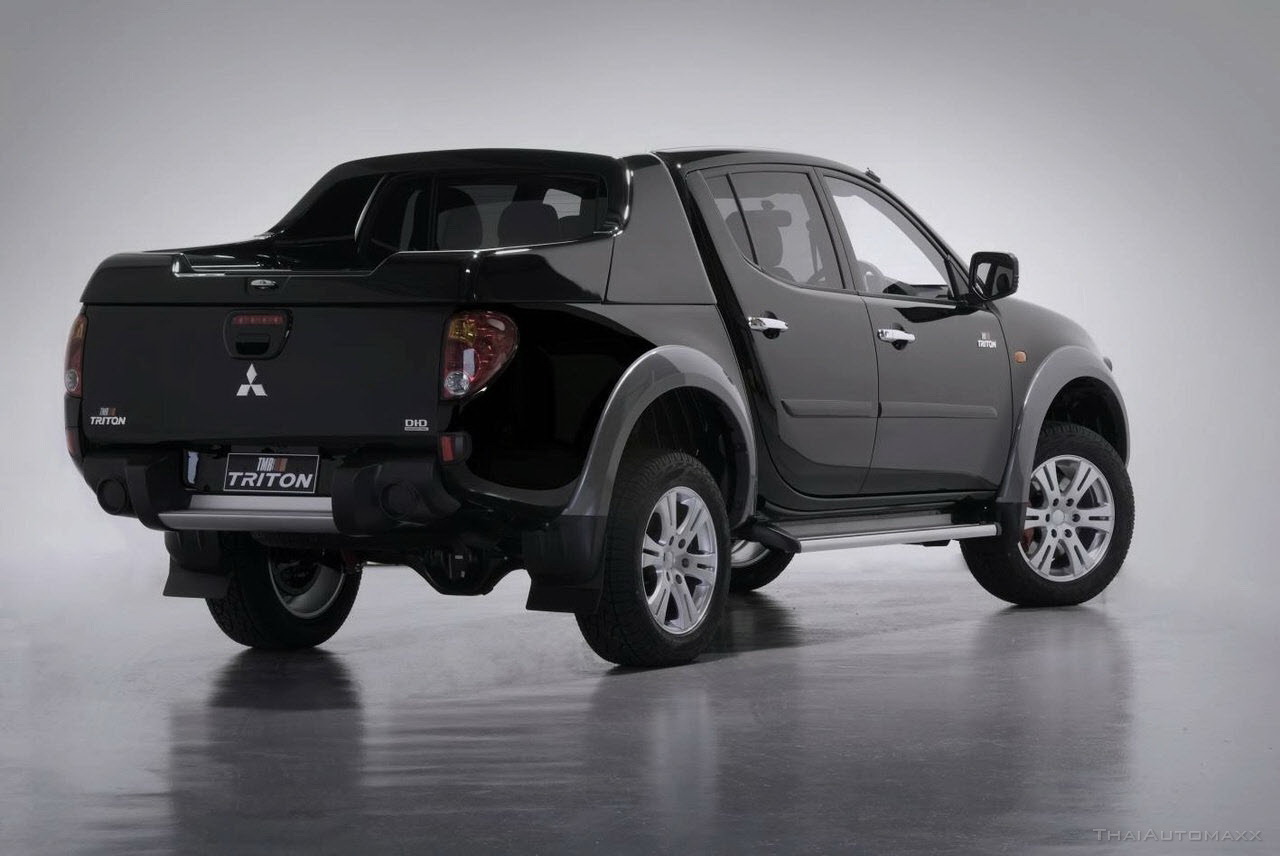
Mitsubishi Triton TMR Concept Strong Car

mitsubishi-triton-tmr-frontI always like the design of the Mitsubishi compact pickup truck. Mitsubishi Triton actually originated in Malaysia as a Mitsubishi Storm. Triton has always had a strong and robust design that attracts many truck buyers. TMR Triton is a concept vehicle which closely represents the reality of production.

mitsubishi-triton-tmr-back-2This concept model will be using 3.2 litre common rail turbo diesel engine that provides an impressive 132kW @ 3,800rpm and torque to a phenomenal 450Nm @ 2,000rmp. This is an increase from the current model. Fitted with Koni 8240 series shock absorbers at the front and back to provide the comfort needed for your weekend out of the town.

mitsubishi-triton-tmr-backMitsubishi Triton uses Super Select 4WD system that enable the driver to choose from 2WD, full time 4WD or 4WD high / low range.

mitsubishi-triton-tmr-bumper
mitsubishi-triton-tmr-interiorThe best of all is the interior that uses leather seat with TMR logo stiched on each 4 seats and the stainless steel scuff plates and full carpet mat set in the interior of this Mitsubishi Triton TMR Concept Pickup Truck.

Thursday, June 11, 2009

Mitsubishi Motors planning five more EV models

The Nikkei reports that Mitsubishi will soon introduce five other electric models, and that by fiscal 2013, it intends to sell upwards of 30,000 electric vehicles and be profitable. Concurrent with beginning production of the i MiEV (earlier post), Mitsubishi Motors had also outlined its “Mitsubishi Motors Group Environmental Vision 2020” roadmap for its near-future, including a production volume at least 20% of which is electric vehicles.

Planned vehicles reportedly include:
  • A left-side-steering version of the i-MiEV for the European market in the second half of fiscal 2010.
  • An electric commercial vehicle that can be used to transport goods in fiscal 2010.
  • During or after fiscal 2011, larger electric vehicle models based on full-sized cars, not minicars. The first, due out sometime in fiscal 2011, will be an electric version of a 1-liter small car.
  • By fiscal 2013, a plug-in hybrid sport utility vehicle.
  • A sport model of the i-MiEV, with better driving performance.
  • The company will also begin supply of an EV on an OEM basis to PSA Peugeot Citroën in fiscal 2010.
Dr. Menahem Anderman, President of Advanced Automotive Batteries, the organizer of the Advanced Automotive Battery Conference being held in Long Beach, California this week, said in one of his market overview presentations that “the most mature EV Li-ion battery on the market today is the GS Yuasa-Mitsubishi EV battery” used in the i-MiEV.

Anderman projected in a value proposition analysis for automotive Li-ion batteries that the small EV and extended range electric vehicle segment—i.e., vehicles with a battery pack of around 15-16 kWh—would lead the short-term lithium-ion market (in terms of dollars), with around 8,000 units being sold by 2011, with about half of those being i-MiEVs.

Source: Green Car Congress

Monday, May 25, 2009

Lithium Energy Japan building second Li-Ion plant for Mitsubishi i MiEV

Lithium Energy Japan, a joint venture between GS Yuasa Corp., Mitsubishi Motors Corp. and Mitsubishi Corp., plans to construct a battery factory in response to Mitsubishi Motors’ plans to boost production of its i MiEV electric vehicle.

The joint venture will spend ¥2-3 billion (US$21-32 million) to build the lithium-ion battery factory in Kyoto. This facility will reportedly have sufficient capacity to produce battery packs for 15,000 vehicles a year starting in the autumn of 2010.

Lithium Energy Japan had initially intended to produce cells for packs for up to 2,000 vehicles a year at GS Yuasa’s main plant, in Kyoto, for a range of customers. In 2008, the company began construction on a factory in Kusatsu, Shiga Prefecture, with eventual planned capacity for approximately 10,000 vehicles. At the time, the company said it was planning to add a second plant and double output by 2012.

With the rapid increase in demand for lower emitting vehicles, Mitsubishi Motors recently doubled its planned i MiEV production for fiscal 2011 to 20,000 following an agreement to supply the car to France’s PSA Peugeot Citroen Group.

In April, Blue Energy Co., Ltd., the new joint venture company between GS Yuasa and Honda for the manufacturing, sales and R&D of lithium-ion batteries for hybrid vehicles, held a groundbreaking ceremony to mark the start of construction of its Osadano Plant in Fukuchiyama, Kyoto.

Source: Green Car Congress

Tuesday, February 3, 2009

Mitsubishi to withdraw from Dakar Rally & all Cross-Country races


Mitsubishi Motors Corporation (MMC) announced today their decision to withdraw from the Dakar Rally, the Dakar Series and all cross-country rallies.

In its twenty-six entries in the event, Mitsubishi Motors won the rally a total of twelve times, including seven consecutive victories. In addition to this unparalleled record the company also gained 4WD technology that informs its production vehicles, most visible in their durability and off road performance.

Th
e sudden deterioration of the global economy made it necessary for the company to focus its resources more tightly, and for this reason the decision was taken to withdraw its Mitsubishi Motorsports (MMSP) works team from all cross-country competitions.


Source: Mitsubishi Motors UK Press Site

Wednesday, December 24, 2008

The economic crisis and the Japanese auto industry - Part 2

Following Toyota's announcement of the results for November 2008, Honda, Mitsubishi, Nissan and Mazda have announced today their results.

Honda Motor Co., Ltd. announced a summary of automobile production, Japan domestic market sales, and export results for the month of November 2008.

Production
Production in Japan and in regions outside of Japan experienced a year-on-year decrease. Worldwide production experienced a year-on-year decrease for the first time in three months (since August 2008).

Japan Domestic Market Sales
Total Japan domestic market auto sales for the month of November 2008, experienced a year-on-year decrease for the first time in two months (since September 2008).

Due mainly to strong sales of the all-new Life , sales of mini-vehicles experienced a year-on-year increase for the first time in nine months (since February 2008).

Vehicle registrations - excluding mini-vehicles
Fit was the industry's second best-selling car among new vehicle registrations for the month of November 2008, with sales of 10,386 units. Freed was the industry's fourth best-selling car with sales of 7,032 units.

Mini-vehicles - under 660cc
Life was the industry's fourth best-selling car in the mini-vehicle category for the month of November 2008, with sales of 10,702 units. Zest was the industry's ninth best-selling car with sales of 3,103 units.

Exports from Japan
Total exports from Japan in November 2008 experienced a year-on-year decrease for the second consecutive month (since October 2008).

--------------------------------------------------------------

Mitsubishi Motors Corporation today announced global production, as well as domestic sales and export figures for November 2008.

Production: total and in Japan
Total global production came in at 91,750 units, a decline of 27.7 percent over November 2007 and the ninth consecutive monthly decrease since March. Production volume in Japan at 55.858 units was down 26.6 percent as a 28.6 percent decrease in passenger car and a 6.6 percent decrease in commercial vehicle output saw year-on-year volume fail to grow for the first time in three months.

Sales in Japan

Vehicle sales in Japan in November totaled 13,044 units, a 31.1 percent decrease year-on-year and the 15th consecutive monthly decline since September 2007. Registration and minicar sales were 45.5 percent and 22.7 percent down respectively on the same month last year.

Production overseas

Overseas production volume totaled 35,892 units, 29.2 percent down over November last year and the ninth consecutive monthly decline. By region, output in North America at 3,281 units was 36.0 percent down as production levels were adjusted for slow sales in the United States.

Export shipments from Japan

Total exports from Japan of 39,917 units were 13.8 percent down on November 2007, for the first time in two months. Exports to North America at 4,563 units were 14.6 percent up on November 2007, driven chiefly by strong sales of the Lancer in Mexico. Exports to Europe at 13,938 units were 6.8 percent up. Exports to Asia at 2,843 units were 36.8 percent down on November 2007.

--------------------------------------------------------------

Nissan Motor Co.,Ltd., today announced its sales, production and export results for November 2008.

Production
Nissan's global production in November decreased 33.7% year-on-year to 222,212 units.
Production in Japan decreased 35.6% year-on-year to 79,649 units.
Production outside of Japan decreased 32.5% year-on-year to 142,563 units.
In the U.S., production decreased 60.2% year-on-year to 26,949 units.
In Mexico, production decreased 11.2% year-on-year to 36,583 units.
In the U.K., production decreased 33.6% year-on-year to 22,348 units.
In Spain, production decreased 84.0% year-on-year to 3,384 units.
Production in the General Overseas Markets (GOM) grew 11.9% year-on-year to 53,299 units due to increased demand in China for the newly released X-TRAIL and Teana.

Sales
Global sales decreased 19.8% to 237,653 units compared to the previous year.
In Japan, Nissan's vehicle registrations in November decreased 29.5% year-on-year to 30,132 units. Nissan's share of the domestic market registrations in November was down 0.4 percentage points year-on-year to 14.0%.
Domestic sales of mini-vehicles were up 3.3% from the previous year to 11,452 units.
Including mini-vehicles, Nissan sold 41,584 units in Japan, down 22.8% year-on-year. Market share was down 0.6 percentage points year-on-year to 11.3%.
Nissan sales in the U.S. decreased 42.2% year-on-year to 46,605 units.
In Europe, sales decreased 30.5% year-on-year to 34,179 units.
Sales in the GOM regions were up 5.1% from the previous year to 94,126 units.

Japan Exports Nissan's exports in November decreased 30.2% to 52,591 units compared to the previous year. Exports to North America decreased 50.3% year-on-year to 17,587 units. Exports to Europe increased 11.6% year-on-year to 5,475 units.

--------------------------------------------------------------

Mazda Motor Corporation’s production and sales results for November 2008 are summarized below.

Domestic Production
Domestic production in November 2008 decreased 19.8% compared to November 2007, despite increased production of the Mazda 2 (Demio) and Mazda 6 (Atenza).

Overseas Production

Although the Mazda6 overseas production volume increased year-on-year, the total overseas production volume of all models decreased 11.0% compared to the same month last year.

Domestic Sales

The domestic sales volume for November 2008 decreased 28.0% compared to November 2007, reflecting a decline in total market demand.
Mazda’s registered vehicle market share was 4.5% (down 0.3 points year-on-year), with a 2.5% share of the micro-mini segment (down 0.4 points year-on-year) and a 3.7% total market share (down 0.5 points year-on-year).

Exports

Despite increased shipments of the Mazda 2, the export volume for November 2008 decreased 14.9% year-on-year due to a decline in shipments of other models.
On a market basis, while the export volume to Europe increased 0.2% compared to the same month last year, export figures for North America and other markets (the Middle East and Africa) decreased when compared to November 2007.

Sources: Honda Motor Co.,Ltd., Mitsubishi Media Service, Nissan Global Website
, Mazda Global Site

Tuesday, December 16, 2008

Will SiC Inverters come in time for EVs?


An Article by Motohiko Hamada, Nikkei Automotive Technology

"I was beginning to become concerned while rushing around to cover SiC (silicon carbide) stories. Will it be ready in time for the era of electric vehicles if things continue like this?


SiC is a
semiconductor used for an inverter that rotates the motors of electric and hybrid vehicles. Silicon (Si) is currently used for this purpose but will be replaced by SiC in the near future. However, the shift to SiC could end up in failure if if timing is wrong.


The energ
y loss with SiC is only half that with Si. Also, the heat generated by SiC is half that of Si, making it easier to release the heat and allowing its use in a high temperature. Si inverters are operable at 200°C, while SiC inverters can be operated at 300°C. And Rohm Co Ltd confirmed that its SiC inverter operated at 400°C, making heat release even easier.


Heat relea
se becomes more effective with smaller heat generation, higher temperature, larger heat dissipation area and better thermal conductivity. If the heat generation is small enough and the temperature is high enough, the surface area and the thermal conductivity can be reduced. The reduction in thermal conductivity means, for example, replacing a water-cooled system with an air-cooled system.


The "Lexu
s LS600h," a hybrid vehicle manufactured by Toyota Motor Corp, has a cooling system that forcefully "water-cools electronics devices that should not get wet" in its inverter. We should not forget the fact that materials with a high thermal conductivity are high in electrical conductivity (low insulation properties) in many cases.


Toyota's technology is fantastic, but there is something wrong with it. If an air cooling system can be used, we will not have to resort to an unreasonable method like this.

When will
SiC be commercialized, exactly?


Mitsubishi Electri
c Corp went further than other companies and expressed its plans to commercialize SiC converters. The company said, "We aim to commercialize it in fiscal 2010," when it made an announcement about its measures against global warming in November 2008. But other companies carefully interpret this announcement, saying "Mitsubishi has users in its group" and "the production volume is unclear."


Manufact
urers other than Mitsubishi only said, "it will be in the 2010s," although I asked them several times. But I understand their attitudes because the progress in SiC technology is difficult to forecast and a number of manufacturers have already failed to predict it. If their previous predictions had been accurate, SiC inverters would have already been realized.


Also, the full-fledged electrification of automobiles is anticipated for the 2010s. For example, JP Morgan Securities Inc predicts that the market scale of gasoline hybrid vehicles will reach 9.62 million in 2018, twenty times the current number.

However,
this prediction is subject to change, depending on crude oil prices and the progress in batteries. They can only say, "it will be in the 2010s," when asked, "When will the full-scale electrification start?"


This is not
the answer we want. The point is "when in the 2010s?" Manufacturers want to use SiC inverters when they produce electric vehicles in full swing. Therefore, the gap between the timings of SiC inverter commercialization and the full-fledged manufacturing of electric vehicles could be a problem.


If the devel
opment of SiC inverters falls behind, manufacturers will have to use Si inverters. Automotive inverters are much larger than those for home electronics and home information appliances. Hybrid and electric vehicles will require a capacity of 15 to 40kw and 40 to 100kW, respectively, which are 10 to 100 times that of an air conditioner.


If electric v
ehicles start to dominate the market, huge volumes of semiconductors will be required. It is believed that the demands for semiconductors will remain low for the time being and the operating rates of semiconductor production facilities will drop. But the excess capacity will not be sufficient to meet the demands arising from the full-swing production of electric vehicles.


Nevertheless
, manufacturers will not make substantial investments in the Si production equipment. This is because they know that Si production equipment will end up as excess facilities, being soon replaced by SiC. This situation could result in a delay in SiC development and a shortage and high price of Si, placing automobile manufacturers in a very serious situation.


We have
a long way to go before seeing the era of electric vehicles."


Source:
Tech-On