Showing posts with label Lithium-Ion. Show all posts

Friday, January 22, 2010

In the race to bring Leaf to the market, Nissan engineers cut corners?!


Nissan's CEO, Carlos Ghosen, is very eager to win the EV race by bringing first to the market the first mass-produced EV. But, the are sacrifices to be made in order to achieve this, as the article explains.

Let's face it, the biggest competitor is GM's Volt, which will be launched about the same time. Carlos Ghosen recently told Bloomberg, “The engineers will always tell you, ‘Wait a little more,’ and if you keep playing this game, you never launch any product.”

Since cars are complicated pieces of engineering, it's easy to understand that EVs present numerous fresh challenges  to the engineers. So, what are the shortcuts? I have summarized them below in order to be easier to identify.

Tuesday, December 15, 2009

Toyota introduces Prius Plug-In Hybrid


Toyota Motor Corporation in Japan has today confirmed the introduction of the Prius Plug-in Hybrid, a plug-in version of the third-generation Prius petrol-electric hybrid vehicle. 

The Prius Plug-in Hybrid Vehicle (PHV) offers greater range on electric power only, significantly reducing fuel consumption and emissions. The PHV uses lithium-ion batteries – a first for Toyota – which can be charged from an external source as well as by the car’s own hybrid drive system.

Approximately 600 units will be introduced in Japan, the United States, and Europe over the first half of 2010.  20 will come to the UK in mid 2010.

The Prius PHVs will be leased to government ministries, local governments, corporations including electric power companies, universities and research agencies, for use in a demonstration programme aimed at collecting real-world driving data and spurring the development of battery-charging infrastructure. 

In Europe, Toyota will lease approximately 200 units, 20 of which will come to the UK in mid-2010. The details of these UK leases will be the subject of a separate announcement closer to the time. The Prius Plug-in Hybrid will also be introduced in France and Portugal, with the company also considering 10 other European countries, including Germany and the Netherlands, along with countries in other regions, such as Canada, Australia and New Zealand.

The Prius PHV can be charged using an external power source such as a household electric outlet and is the first vehicle produced by Toyota to be propelled by a lithium-ion battery.  Further, due to the battery's expanded capacity, the vehicle has an extended electric-vehicle driving range, enabling use as an electric vehicle (EV) for short distances. While for medium and long distances, after battery power depletes to a level no longer allowing EV driving mode, the vehicle functions as a conventional petrol-electric hybrid vehicle (HV). Thus, use is not constrained by remaining battery power or availability of battery-charging infrastructure.

Furthermore, PHVs, such as the Prius Plug-in Hybrid, are expected to achieve fuel efficiency superior to conventional petrol-electric HVs, reduce consumption of fossil fuels and reduce CO2 emissions and atmospheric pollution.  Verifications and rules that gauge the performance of a PHV (i.e. official fuel consumption tests) differ from region to region, but in Europe, the Prius PHV emits only 59g CO2 per km in the New European Driving Cycle*.

"The Plug-in Hybrid technology is a key driver on our road towards sustainable mobility," said Toyota Motor Corporation (TMC) Executive Vice-President Takeshi Uchiyamada. "Based on Toyota's full hybrid powertrain, PHV represents today the most practical way of increasing the use of electricity for personal transport. Now we need to investigate market acceptance of this new technology."

Toyota believes that to meet the diversification of energy sources plug-in hybrid vehicles are a highly suitable environmentally considerate option.  Toyota is therefore actively encouraging market introduction to aid understanding and to promote the early widespread use of PHVs. Toyota will analyse feedback regarding the Prius Plug-in Hybrid, with an aim to begin sales in the tens of thousands of units to the general public in two years.

Toyota promotes the use of alternative energy sources, such as electricity, to limit the consumption of fossil fuels and to reduce CO2 emissions.  Thus, the company is accelerating the development of electricity-related technologies honed by experience gained from 12 years selling petrol-electric HVs, the market introduction of the RAV4 EV SUV and the leasing of fuel-cell HVs.

*(CO2 emissions of Prius Plug-in Hybrid are measured according to the new official international regulation for plug-in hybrid electric powertrains, as adopted by the United Nations Economic Commission for Europe).

VEHICLE SPECIFICATIONS
 
Engine displacement
1,797 cc
Transmission
Electric automatic
Powertrain
Front-wheel drive
Length
4,460 mm
Width
1,745 mm
Height
1,490 mm
Wheelbase
2,700 mm
Track  - Front
           - Rear

1,525 mm
1,520 mm

Weight
1,490 kg
Seating capacity
5
Minimum turning radius
5.2m
Tyre size
185/65R15

HYBRID SYSTEM SPECIFICATIONS
 
System
THS II Plug-in (with motor speed reduction device)
Engine
1.8-litre gasoline 2ZR –FXE (high-expansion ratio)
Maximum output
73 kW (99PS)/5,200rpm
Maximum torque
142 N-m (14.5 kgf-m)/4,000rpm
Motor
3JM (permanent magnet)
Maximum output
60 kW (82 PS)
Maximum torque
207N-m (21.1kgf-m)
Drive battery
Lithium-ion
Capacity
5.2 kWh
Rated voltage
345.6 V
Charging time
Approx. 180 minutes (AC100 V)
Approx. 100 minutes (AC200 V)

System maximum output
100 kW (136 PS)
System voltage
Max. 650 V
EV mode maximum speed
approx. 100 km/h (62mph)

Source: Toyota

Wednesday, November 18, 2009

Prius Plug-in Hybrid' Lease Discussions Begin in Japan


TOYOTA MOTOR CORPORATION (TMC) announces that it has started discussions with potential users in Japan of the newly developed "Prius Plug-in Hybrid". Approximately 200 units will be leased through a leasing company to designated parties such as government ministries, local governments and energy companies that are actively promoting environmentally considerate vehicles.

The designated parties are principally participants in the Ministry of Economy, Trade and Industry's "EV & PHV Towns" program*, which aims to promote the widespread use of electric vehicles (EVs) and plug-in hybrid vehicles (PHVs).

Details of the leasing scheme for Japan will be determined through November, with delivery scheduled for mid-December onward. The vehicles will only be leased to parties already designated by TMC.

The Prius Plug-in Hybrid is based on the third-generation "Prius" and is equipped with a lithium-ion battery that can be charged using an external electric power source. The vehicle can be used as an EV for short distances, while for medium- and long-distance trips it functions as a conventional gasoline-electric hybrid, meaning use is not constrained by remaining battery power or availability of battery-charging infrastructure. Furthermore, PHVs, such as the Prius Plug-in Hybrid, are expected to achieve higher fuel efficiency than conventional hybrid vehicles, limit consumption of fossil fuels, and reduce CO2 emissions and atmospheric pollution.

TMC believes that, to meet the diversification of energy sources, PHVs are currently the most-suitable environmentally considerate vehicles for widespread use. TMC is therefore encouraging PHV market introduction and understanding toward widespread use by introducing a total of 500 units of the Prius Plug-in Hybrid globally - primarily to fleet customers. Approximately 150 units will go to the United States, and more than 150 units will go to Europe, to countries including France, the United Kingdom and Portugal.

TMC has positioned hybrid technologies as core environmentally considerate vehicle technologies and is using them in the development not only of plug-in hybrid vehicles but also electric vehicles and fuel-cell hybrid vehicles. TMC will continue its efforts in developing and putting into practical use these next-generation vehicles, which are hoped to contribute to reducing petroleum consumption, reducing CO2 emissions and responding to the diversification of energy sources.

* An intensive model program, through the collaboration of the national and local governments, regional businesses and auto manufacturers in Japan, for the introduction and promotion of electric vehicles and plug-in hybrid vehicles as well as for accelerating the setting up of charging infrastructures and the development of societal awareness and preparedness. Each participating local government is to submit by around the end of this financial year a master plan that reflects the progress of its action plan.


Source: Toyota

Tuesday, October 27, 2009

Honda's future: small cars, no NSX or Euro Acura

Honda chief executive Takanobu Ito today spelled out his vision for the next decade at Honda to CAR Online. No successor to the NSX is under development, but there will be a smaller city car slotting under the Jazz in Honda's range. It will be launched in Asia at first, potentially following in the rest of the world.

Ito, who is also president of Honda R&D, said that the company had no firm plans for a pure battery electric vehicle at this stage – the onus is on hybrid petrol electric cars and fuel-cell models.

It will continue to develop diesels for Europe, but Ito admitted a project to build clean-fuel diesels for the US market had been cancelled. He also expressed regrets over pulling out of F1, but said it made sound business sense to pump the money saved back into developing eco technologies.

What next for Honda's hybrids?

Speaking to CAR at the 2009 Tokyo motor show, CEO Ito said that future Hondas would use one of two hybrid systems. Small cars of Civic size or below would use a single-motor part-electric system, whereas bigger hybrid cars would use two electric motors.

He also confirmed that future Honda road cars would use direct injection tech, and that his company was researching turbocharging. At present, forced induction is only used on turbodiesels, but Honda acknowledges that downsizing allowed by blown, smaller capacity engines will be key to lowering CO2 and emissions.

And what of the top end Hondas?

Ito ruled out any launch of the Acura brand in Europe, to challenge Lexus and the newly launched Infiniti. He also scotched rumours of a planned new-generation NSX, even a hybrid one.

Fuel-cell cars, like the FCX, will continue to be leased rather than sold outright – until Honda can mass develop the tech to be available at a more affordable price.

Source: CAR magazine

Sunday, October 4, 2009

Panasonic to use PC batteries to power cars


Japan's Panasonic Corp. has developed a technology that binds together standard lithium-ion battery cells used in laptop personal computers to power electric vehicles, taking aim at growing demand for green cars.

The company said that new technology will likely enable Panasonic to make electric car batteries at half the cost of lithium-ion batteries that are developed solely for electric cars, since it can use existing battery plants and production expertise.

Mitsubishi Motors Corp.'s i-MiEV, the world's first mass-produced electric car, sells for 4.6 million yen ($51,000) before government subsidies due mainly to the high cost of its lithium-ion batteries.

Panasonic, which vies with Sony Corp. for the position as the world's largest consumer electronics maker, said it aims to commercialize the battery as early as in four years, but added it is too early to comment on sales targets. The newly developed batteries can also be used at home to store electricity generated by solar panels and fuel cells.


Source:
Automotive News

Tuesday, September 1, 2009

Toyota to reveal Auris Hybrid and Prius Plug-in Hybrid concepts at IAA 2009


The Toyota Auris HSD Full Hybrid Concept will take centre stage for Toyota at the 2009 Frankfurt Motor show.

The concept represents a milestone in Toyota’s strategy: introducing Toyota’s full hybrid technology to a mainstream model, and the first step in the deployment of Hybrid Synergy Drive across the company’s model range.

The new Prius Plug-in Hybrid Concept will also make its world premiere in Frankfurt. Prius Plug-in Hybrid expands the capabilities of Toyota’s full hybrid technology, enabling pure electric operation for short-range day-to-day transportation. In early 2010, an extensive field trial in Europe will see over 150 units being leased to selected fleet customers.

Frankfurt will also stage the European Premiere of the iconic, all-new Toyota Land Cruiser, which will go on sale in the fourth quarter of 2009.

Two customised iQ show cars, iQ for Sports and iQ Collection, will also be on display.


Source: Toyota GB

Tuesday, August 11, 2009

Ghosn: Electric cars worth the billions being invested (...and Leaf's Li-Ion batteries alone cost about $10,000 per vehicle)


Japan--Nissan CEO Carlos Ghosn says the potential payoff from pioneering zero-emission cars is worth the risk of investing billions.

Electric vehicles could take 10 percent of the global market by 2020, or roughly 6 million units in annual sales, Ghosn said.

His comments came during the unveiling of the near-production version of Nissan's new electric four-door Leaf hatchback, which goes on sale next year. Nissan showed the Leaf at the Aug. 2 opening of its new global headquarters here.

Where rivals see a niche, Nissan has "a completely different vision," Ghosn said. "We see it as mass market."

Electric-vehicle sales hardly even register in today's market. But Nissan Motors, after long trailing Honda Motors and Toyota in hybrid vehicle technology, sees its lithium ion battery-powered electric vehicles as a way to jump ahead in the green-car race.

The plan calls for funneling billions of dollars over the next several years into building electric-vehicle assembly lines and battery plants for the cars in the United States, Europe, and Japan.

Nissan expects its electric-vehicle production capacity to reach 200,000 units a year by 2012.

It has already won a $1.6 billion low-interest loan from the U.S. government to start production at its Smyrna, Tenn., complex. But that will likely be a fraction of the global outlay.

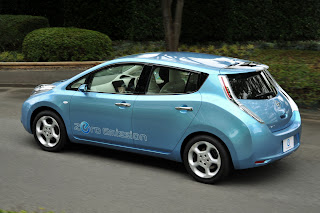
Nissan chose the name Leaf for its new electric car because it has light, airy, natural connotations, said Nissan chief designer Shiro Nakamura. The sky-blue Leaf shown Aug. 2 is very close to production version that will go on sale next year in the United States and Japan, he added.

Designers sought a distinctive green-car look but shunned the stereotypical toylike appearance of electric concept cars in favor of lines that recall a "real car," Nakamura said.

The Leaf seats five adults and is slightly wider and longer than the Nissan Versa. It has a range of 100 miles per charge. Pricing has not been announced--and price will be a key challenge.

The Leaf's lithium ion batteries alone cost about $10,000 per vehicle, said Noboru Tateishi, program director for Nissan's electric vehicle projects.

Ghosn said the goal is to bring the price of the car, minus the battery, to the same range as a comparable gasoline-engine car. Consumers likely would lease the battery at a cost that, including charging, will be cheaper than what they would have paid for gasoline, he said.

Nissan wants to mass-market its electric vehicles globally by 2012.


Source: Automotive News via
The Car Tech blog

Thursday, August 6, 2009

Nissan retailing of the Leaf electric vehicle starts next year in five markets

Just days after pulling the wraps off of its prototype Leaf electric vehicle in Japan, Nissan Motor Co. says it has committed to an early launch of 5,000 sales in the United States, starting late next year.

The plan will require Nissan North America to begin retailing the Leaf at U.S. dealerships two years ahead of the schedule outlined by Nissan CEO Carlos Ghosn.

The first 5,000 U.S. Leafs will take part in a five-market study of electric-vehicle driving habits. Nissan and various public utilities and government agencies want to make sure they understand how consumers recharge their vehicles.

Mark Perry, Nissan's director of product planning and strategy, says it is not merely a market test but rather the bona fide launch of mass electric-vehicle retailing.

"We're moving fast," Perry says. "This is not a test to determine whether or not it's going to work. This is the beginning of mass marketing."

Buy them

Customers will buy the cars from dealerships. But they must agree to have their recharging habits monitored through an onboard black box for their first two years of ownership.

Nissan will qualify which consumers get to purchase the first 5,000 Leafs. Perry says there will be some screening to make sure the cars are purchased by consumers who can provide meaningful data.

"We don't want these first cars going to somebody who commutes 150 miles a day or who lives a great distance from a recharging station," he says.

Nissan has said the Leaf will be affordable, but it has not revealed the price.

DOE money

The catalyst behind the early startup is a $99.8 million grant from the U.S. Department of Energy to Electric Transportation Engineering Corp., a Phoenix technology supplier. That firm must install 12,500 recharging stations in Nissan's first five markets: the Phoenix-Tucson corridor of Arizona; Oregon; San Diego; Seattle and Tennessee.

Matching funds are being provided by the cities and states, for a total investment of $199.6 million.

The recharging data will be turned over to the Department of Energy, which required Nissan to have 1,000 vehicles on the road in everyday use to make the data valid.

Nissan originally said it would launch electric-vehicle fleet sales in the United States in 2010 and start retail sales through its dealerships in 2012. But Perry has maintained that retail sales could start earlier than 2012 if individual markets and dealers were ready.

Perry says Nissan still intends to launch U.S. fleet sales of the electric car next year. Those sales will be in addition to the 5,000 cars participating in the data collection.

Source: Autoweek

EV's computer combats will-I-make-it anxiety


Nissan Motor Co.'s new electric vehicle comes with a computer system aimed at allaying drivers' fears that they will be stranded midtrip by dead batteries.

The system taps navigation maps, cell phones and a 24-hour global data center to keep drivers apprised of how much farther they can drive.

"One of the fears of customers is what happens when you run out of electricity," Nissan r&d chief Mitsuhiko Yamashita said last week at Nissan's Oppama technical center before the car's Aug. 2 unveiling. "This charging support gives drivers a secure feeling and will help EVs become more widely accepted."

The navigation system shows a map with the driving radius of one-way and round trips possible given the car's current charge.

It can calculate whether the vehicle is within range of a preset destination. The car also tracks all charging stations within range in case its lithium ion batteries need more juice.

All of this will be updated continuously through a real-time connection to a global data center that will operate around the clock. The car uses mobile phones to connect the information technology system to the Internet. Mobile phones also will be used to communicate with the car when it isn't moving.

Customers can use the phones to check the status of their batteries while they wait for a recharge.

Drivers also can dial in before starting their drive to remotely start the car's air conditioner and thereby extend battery life. That sounds counterintuitive, but here's why it makes sense: When people get into a hot car, they typically turn the air conditioner on full blast in an energy-intensive attempt to cool off. But starting the air conditioner in advance at a weaker setting before getting in helps conserve the battery's charge.

Nissan plans to make the cars at its Smyrna, Tenn., plant and in Japan and Europe. The Tennessee factory will have capacity for 150,000 vehicles a year. Production is scheduled to begin in late 2012. Nissan aims to sell three electric models by 2013.

Source: Automotive News via CNET Reviews

Wednesday, August 5, 2009

Mitsubish i-Miev: Available in Europe from 2010 for €34,000


Mitsubishi i-Miev will be available in UK from 2010 with prices starting from approximately €34,000. i-Miev is expected to be available in main European markets around 2012.

The price is expected to be lowered at around €15,000 by 2012 as the production will be increased to 30,000 cars/year.

Source:
autoblog.it

Sunday, August 2, 2009

Nissan unveils "Leaf" - World's first electric car designed for affordability and real-world requirements (日産自動車、手頃な価格とニーズを満たす電気自動車「リーフ」を公表)


YOKOHAMA, (Aug. 2, 2009) - Nissan Motor Co., Ltd. today unveiled Nissan LEAF, the world's first affordable, zero-emission car. Designed specifically for a lithium-ion battery-powered chassis, Nissan LEAF is a medium-size hatchback that comfortably seats five adults and has a range of more than 160km (100 miles) to satisfy real-world consumer requirements.

NISSAN LEAF
Slated for launch in late 2010 in Japan, the United States, and Europe, Nissan LEAF ushers in a new era of mobility - the zero-emission era. The car is the embodiment of Nissan's radical, transformative vision for the future and the culmination of decades of investment and research.

"Nissan LEAF is a tremendous accomplishment - one in which all Nissan employees can take great pride," said Nissan President and CEO Carlos Ghosn. "We have been working tirelessly to make this day a reality - the unveiling of a real-world car that has zero - not simply reduced - emissions. It's the first step in what is sure to be an exciting journey - for people all over the world, for Nissan and for the industry."

Key characteristics of the LEAF include:

1) Zero-emission power train and platform
2) Affordable pricing
3) Distinctive design
4) Real-world range autonomy - 160km (100 miles)
5) Connected Mobility: Advanced intelligent transportation (IT) system

The "LEAF" name is a significant statement about the car itself. Just as leaves purify the air in nature, so Nissan LEAF purifies mobility by taking emissions out of the driving experience. Pricing details will be announced closer to start of sales in late 2010; however, the company expects the car to be competitively priced in the range of a well-equipped C-segment vehicle. Additionally, Nissan LEAF is expected to qualify for an array of significant local, regional and national tax breaks and incentives in markets around the world. As an added benefit, because the vehicle has less mechanical complexity than a traditional gasoline-powered car, Nissan LEAF is designed to be friendly to the wallet as well as to the environment.

ZERO-EMISSION MOBILITY
Nissan LEAF is powered by laminated compact lithium-ion batteries, which generate power output of over 90kW, while its electric motor delivers 80kW/280Nm. This ensures a highly responsive, fun-to-drive experience that is in keeping with what consumers have come to expect from traditional, gasoline-powered automobiles.

Unlike internal-combustion engine (ICE) equipped vehicles, Nissan LEAF's power train has no tail pipe, and thus no emission of CO2 or other greenhouse gases. A combination of Nissan LEAF's regenerative braking system and innovative lithium-ion battery packs enables the car to deliver a driving range of more than 160km (100 miles) on one full charge*. (*US LA4 mode)

Extensive consumer research demonstrates that this range satisfies the daily driving requirements of more than 70% of the world's consumers who drive cars.

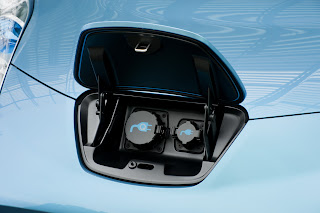
And, Nissan's approach makes charging easy and convenient. Nissan LEAF can be charged up to 80% of its full capacity in just under 30 minutes with a quick charger. Charging at home through a 200V outlet is estimated to take approximately eight hours - ample time to enable an overnight refresh for consumer and car alike.

REAL-WORLD CAR
The engineers and designers behind Nissan LEAF worked to create a competitively priced real-world car that would enable Nissan to lead mobility into the zero-emission era. To ensure comfort, spaciousness and cargo capacity, Nissan LEAF employs a completely new chassis and body layout.

"Our car had to be the world's first, medium-size, practical EV that motorists could afford and would want to use every day. And that's what we've created. The styling will identify not only Nissan LEAF but also the owner as a participant in the new era of zero-emission mobility," said Masato INOUE, Product Chief Designer.

DISTINCTIVE DESIGN
Even the smallest details can yield tremendous effect.

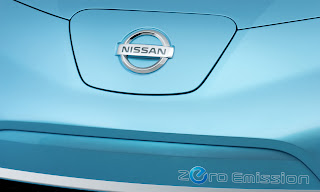
Nissan LEAF's frontal styling is characterized by a sharp, upright V-shaped design featuring long, up-slanting light-emitting diode (LED) headlights that employ a blue internal reflective design that announces, "This car is special." But the headlights do more than make a statement. They are also designed to cleverly split and redirect airflow away from the door mirrors, thus reducing wind noise and drag. And, the headlights provide yet one more benefit in that they consume about 50 percent of the electricity of conventional lamps, which helps Nissan LEAF to achieve its world-class range autonomy.

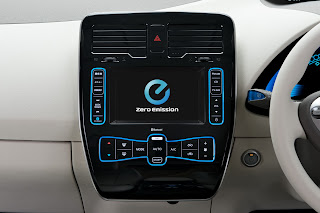
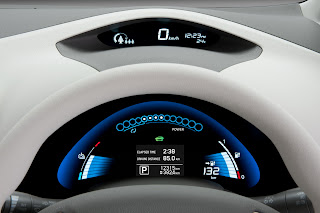
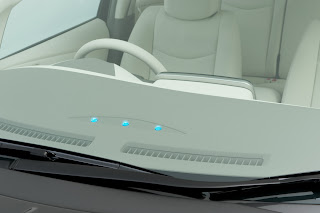
Through bright trim colors inside, Nissan LEAF creates a pleasing and stylish cabin environment. An environmentally friendly "blue earth" color theme originates from the Aqua Globe body color of Nissan LEAF's introductory model. This theme is carried into the interior through blue dashboard highlights and instrument illumination.

CONNECTED MOBILITY IT SYSTEM
Nissan LEAF employs an exclusive advanced IT system. Connected to a global data center, the system can provide support, information, and entertainment for drivers 24 hours a day.

The dash-mounted monitor displays Nissan LEAF's remaining power - or "reachable area" - in addition to showing a selection of nearby charging stations.

Another state-of-the-art feature is the ability to use mobile phones to turn on air-conditioning and set charging functions - even when Nissan LEAF is powered down. An on-board remote-controlled timer can also be pre-programmed to recharge batteries.

"The IT system is a critical advantage," says Tooru ABE, Chief Product Specialist. "We wanted this vehicle to be a partner for the driver and an enhancement for the passengers. We also wanted this vehicle to help create a zero-emission community, and these IT features will help make that possible."

HOLISTIC APPROACH TO ZERO-EMISSION MOBILITY AND ECO-FRIENDLY INNOVATION
Nissan LEAF is a critical first step in establishing the era of zero-emission mobility; however, Nissan recognizes that internal-combustion engine (ICE) technologies will play a vital role in global transportation for decades to come. Because of this, Nissan is implementing its zero-emission vision through a holistic approach, which provides consumers a comprehensive range of eco-friendly technologies from which to choose.

For some consumers, Nissan LEAF will be the perfect match, and the only car they will ever need. For others, Nissan LEAF will be a logical addition to the family fleet - the optimal choice for the daily commute, for example.

While zero-emission is the ultimate goal, the company is committed to ongoing innovation in eco-friendly technologies that increase efficiency and reduce emissions. As a result, Nissan offers a comprehensive suite of automotive technologies, including CVT, Idle Stop, HEV, Clean Diesel, and ongoing research and investment in FCV technology.

WORLDWIDE PARTNERS
Zero-emission mobility programs under the banner of the Renault-Nissan Alliance include partnerships with countries such as the UK and Portugal, local governments in the Japan and the USA, and other sectors, for a total of nearly 30 partnerships worldwide.

In these partnerships major efforts focus on three areas:

1) Development of a comprehensive charging infrastructure through public and private investment,
2) Incentives and subsidies from local, regional, and national governments, and
3) Public education on the individual and societal benefits of zero-emissions mobility.

ZERO-EMISSION VEHICLE PRODUCTION
Nissan LEAF is the first in the company's forthcoming line of EVs and is a major milestone in the realization of the Renault-Nissan Alliance's vision for zero-emission mobility. The first of Nissan's EV's will be manufactured at Oppama, Japan, with additional capacity planned for Smyrna, Tennessee, USA. Meanwhile, lithium-ion batteries are being produced in Zama, Japan, with additional capacity planned for the USA, the UK and Portugal, and other sites for investment are under study around the world.

-----------------------------------------------------------------------------
Text in Japanese

日産自動車株式会社(本社:東京都中央区銀座 社長:カルロス・ゴーン)は2日、横浜に完成したグローバル本社ビルのオープニングに合わせて、ゼロ・エ ミッション車「リーフ」をマスコミに初披露した。「リーフ」はリチウムイオンバッテリーを搭載した量産電気自動車(EV)として専用に設計・デザインされ たモデルであり、大人5人が乗ってもゆとりある空間と、お客さまのニーズを満たす160km(100マイル)以上の航続距離を実現している。

日産「リーフ」
「モビリティの新しい時代、ゼロ・エミッションの時代」をメッセージとして掲げる新開発の「リーフ」は、2010年度後半に北米、日本のみならず、欧州で も発売される。「リーフ」は、日産の将来に向けた画期的で革新的なビジョンと、何十年にも亘る投資と研究の集大成である。

社 長のカルロス ゴーンは、「日産『リーフ』は、全ての日産の従業員が誇りを感じて良いほど、非常に素晴らしい出来となった。私たちは、エミッションが少ないのではなく、 エミッションがゼロとなるクルマを公開するこの日を実現するために懸命に取り組んできた。これは世界中の人々が間違いなくエキサイティングに感じる新しい 時代に向けた最初の一歩である。」と、述べた。

「リーフ」の特徴は以下の5つである。

  • ゼロ・エミッションなパワートレインとプラットフォーム
  • お求めやすい価格
  • EVとしての独自デザイン
  • 日常の使用に十分な航続距離 - 160km(100マイル)
  • ITシステムによるアシスト(ゼロ・エミッションEV専用ITシステムを搭載)

「リーフ」という車名は、このクルマを表す顕著なネーミングであり、自然界において葉が大気を浄化するように、日産リーフが走行時の排出ガスをなくすことを意味する。

「リー フ」の価格は2010年末に発表する予定であるが、Cセグメントの車両と同等の競争力を持たせることを標榜している。また、「リーフ」は、世界中の政府お よび地方自治体等の減税措置や補助金の対象となることが見込まれる。さらに、「リーフ」は、従来のガソリン車と比較して経済性と環境に配慮したクルマと なっている。

1) ゼロ・エミッション
従来の内燃エンジン(ICE)と異なり、「リーフ」は90kW超の出力を発生するラミネート型コンパクトリチウムイオンバッテリーと80kW/280Nm を発揮する電気モーターを搭載する。これにより、従来のガソリン車と同等の高いレスポンスと運転の楽しさを味わうことができる。

またICE車と違い、このEVのパワートレインは、走行中にCO2やその他排出ガスを一切出さない。この革新的な新型リチウムイオンバッテリーと協調回生ブレーキシステムの搭載により、リーフは1回のフル充電で160km(100マイル)以上の航続距離を可能としている*。(*US LA4モード)

お客さまを対象とした広範なリサーチでは、世界中のドライバーの70%以上の日常の運転距離は、この160kmという航続距離の範囲内であるという結果が出ている。

日 産は、簡単で便利な充電方法にも取り組んでいる。「リーフ」は、急速充電器を使えば、30分以内で電池容量0%から80%までの充電が可能となる。また、 家庭での充電時間は200Vの普通充電で電池容量0%から満充電まで約8時間となり、ひと晩の充電でまかなうことができる。

2)お求めやすい価格で毎日使えるグローバルリアルカー
ゼ ロ・エミッション車でグローバルリーダーとなることを目指し、日産の商品企画、エンジニア、デザイナーはお求めやすい価格のリアル・ワールドカーを創るこ とに専心した。「リーフ」は、快適性と居住性、広い荷室を確保するため、全く新しいシャシーと車体レイアウトを採用している。

デザ インを担当したプロダクト・チーフ・デザイナー(PCD)の井上真人は「『リーフ』は、世界初の、手頃な価格で毎日使いたくなるような実用的な中型のEV とする必要があった。そして私たちはそのようなクルマを創り出した。このクルマのスタイリングは、一目で「リーフ」であると分かるだけではなく、そのオー ナーをゼロ・エミッションモビリティの新時代の一員としてみなす役割を果たすだろう。」と語った。

3)EVとしての独自デザイン
どんなに小さな要素でさえも大きな効果を生む。

「リーフ」は、そのデザインコンセプトを「スマート・フルディティ(賢い流動体)」とし、クリーンなイメージと、知性を感じるデザインに、最高の空力と風 音性能を実現するボディと、革新的で独創的な5人乗り5ドアハッチバックのパッケージングを実現した。コンパクトな新型リチウムイオンバッテリーをフロア 下に配置することにより、後部席のレッグルームとヘッドルームにも余裕が生まれ、快適なスペースを空力性能とともに確保している。

エ クステリアは、V字型の特徴的な低いフロント・エンドに、大型LED式ヘッドランプを配し、ひと目で日産のEVとわかる個性的で上品なスタイリングとして いる。ボディから突き出た独特のヘッドランプは気流を分散してドアミラーを避け、風切り音と空気抵抗を低減する効果を生みだしている。印象的に青く光る内 蔵反射型デザインを採用したヘッドランプが消費する電力は、従来のヘッドランプの約50%であり、航続距離に与える影響を最小限に抑えている。

「リー フ」のインテリアのトリムに使われている明るいカラーにより、楽しくスタイリッシュな室内空間が実現している。インテリアカラーは、環境への配慮を印象づ ける、「リーフ」のボディカラーである「アクアグローブ」を基にした「ブルーアース」を使用している。また、ブルーをEVのアイコンカラーとしてダッシュ ボードのアクセントや計器類のイルミネーションにも採用している。

4)ITシステムによるアシスト
「リーフ」はゼロ・エミッション車専用の高度なITシステムを採用している。グローバルデータセンターに24時間接続可能なこのシステムが運転者をサポートする。

センターコンソールに搭載されたモニターには、エネルギー残量に応じた到達可能エリアや充電ステーション位置が表示される。

エアコンと充電機能は、スイッチを切った状態で携帯電話を使って遠隔操作することが可能であり、リモートコントロール・タイマーによって、予めバッテリーの充電開始時間を設定しておくこともできる。

「リー フ」の商品企画を担当したチーフ・プロダクト・スペシャリスト(CPS)の阿部徹は、「このクルマに搭載したITシステムは、運転者や同乗者にとってパー トナーのような存在であって欲しいと思っている。」と語った。これらの新しいITシステムの機能が、便利なモビリティの新しいスタイルを提供することを可 能にしている。

ゼロ・エミッションモビリティに向けた総体的なアプローチおよび環境に配慮した技術の開発
「リーフ」は、ゼロ・エミッションモビリティの時代を確立していく上で、極めて重要な最初の一歩となる。日産は、一方で内燃機関(ICE)技術は今後数十 年間の移動手段においてグローバルに必要不可欠な役割を担うと認識している。それゆえ、日産はゼロ・エミッションのビジョンを総体的なアプローチで捉え、 環境に配慮した様々な技術を選択肢として幅広くお客さまに提供している。

日産の「リーフ」は理想的なクルマであり、もう「リーフ」しか必要ではないと考えるお客さまもいれば、「リーフ」は、家族の足として買い足すにはふさわしいクルマであり、例えば、毎日の通勤には最適だと考えるお客さまも想定される。

最 終的なゴールはゼロ・エミッションであるが、日産は、燃費を向上させ排出ガスを削減する環境に配慮した技術の開発に引き続き取り組んでいる。その結果とし て、CVT、アイドルストップ、HEV、クリーンディーゼルなど幅広い自動車関連技術を提供し、また、FCV技術への投資・研究にも取り組んでいる。

ゼロ・エミッションモビリティのグローバルパートナーシップ
ルノー・日産アライアンスにおけるゼロ・エミッションモビリティプロジェクトでは、英国やポルトガルなどの各国政府、また、日本および米国での地方自治体、それ以外にも他セクター等、グローバルでおよそ30のパートナーシップを締結している。

これらパートナーシップにおける主な取り組みは以下の通り。

  1. 官民からの投資による広範な充電インフラの開発
  2. 各国政府、地方自治体からの優遇措置および補助金の提供
  3. 個人の利益び社会的利益に資するためのゼロ・エミッションモビリティに関する啓蒙・教育活動

ゼロ・エミッション車の生産工場
「リーフ」は、今後発表される日産のEVラインアップの最初のモデルであり、ルノー・日産アライアンスのゼロ・エミッションモビリティというビジョンの実 現において重要なマイルストーンとなる。「リーフ」はまず、追浜工場で生産される他、米国テネシー州にあるスマーナ工場での生産も計画されている。一方 で、リチウムイオンバッテリーは座間で生産開始予定であり、それ以外にも米国、英国、ポルトガルでの生産も予定されている。また、その他にも世界中で生産 施設の候補地の検討がされている。

日 産は、「青い地球を守りたい」「人や社会と共生する企業市民でありたい」という想いを「ブルーシチズンシップ」という言葉で表し、さまざまな取り組みを 行っている。それは、地球環境保護、地域社会への貢献、ダイバーシティ(多様性)の推進、そしてより多くの人びとにクルマで移動する喜びを提供することな ど、極めて多岐にわたる。このブルーシチズンシップの考え方に基づき、EV開発の取り組みを引き続き推進するとともに、真に実効性のある技術、商品、サー ビスを開発し、市場に投入していく。日産は、今後も提携パートナーであるルノー社と共同でゼロ・エミッション・モビリティに向けて主導的役割を果たしてい く。

日産ゼロ・エミッションサイト:
http://www.nissan-zeroemission.com/JP/

-----------------------------------------------------------------------------

Source: Nissan

Thursday, July 30, 2009

Mitsubishi discloses what will come after i-MiEV

Mitsubishi Motors Corp will expand the lineup of its electric vehicles (EV).

Following the i-MiEV, which was launched in July 2009, the company is now planning to release an EV that is based on the platform of the i-MiEV and has a larger storage space for business use by 2012.

Subsequently, Mitsubishi Motors plans to introduce the "Global Small," a new platform of about 1.0-liter displacement, and make it support EVs in 2012 or 2013. Because the platform is larger than the i-MiEV, which is based on a light car, it is suited for vehicles to be sold outside Japan. It is a front-wheel-drive vehicle unlike the i-MiEV, a rear-wheel-drive vehicle.

Furthermore, Mitsubishi Motors intends to release a plug-in hybrid vehicle equipped with an engine and motor to electrify cars with large-displacement engines in about 2013, defining them as advanced forms of the iMiEV. It will be mounted with a small-engine to charge the battery.

Source: Tech-On!

Tuesday, July 28, 2009

Nissan unveils contactless charging system for EVs


Nissan Motor Co Ltd disclosed that it is developing a contactless charging system for electric vehicles at its briefing session.

The company aims to employ the system for the "next generation" of its electric vehicle scheduled to be released in fiscal 2010.

This time, Nissan Motor equipped the "Hyper Mini," its electric vehicle launched in 2000, with the contactless charging system and had a demonstration of charging it. The system was developed by Nissan Motor and Showa Aircraft Industry Co Ltd. It is an electromagnetic induction type, which supplies electric power between a feeding coil and a receiving coil. The rated output is 10kW.

Nissan Motor is planing to offer the contactless charging system for the next-generation electric vehicle as an option. And it is considering a 3kW-class system for home use. As for the pricing, the company expects the vehicle-mounted system will be priced at several tens of thousands of yen.

Also, as a future challenge, Nissan Motor cited the need to establish a system that can ensure a high charging efficiency even when a feeding coil and a receiving coil are misaligned in a horizontal direction. Specifically, it aims to charge an electric vehicle when the two coils are misaligned as much as 100mm in a horizontal direction.


Source:
Tech-On!

Nissan readies its Electric Vehicle platform


TOKYO (July 27, 2009) - Nissan Motor Co., Ltd. today previewed its electric vehicle (EV) platform on a Tiida-based prototype to demonstrate the superior driving pleasure of a pure zero-emission vehicle. It also showcased a sophisticated EV-IT system developed to support electric driving 24/7 (24 hours a day, 7 days a week).


The dedicated EV platform is comprised of a highly rigid body, high-performance motor, compact lithium-ion battery with high power output and energy capacity, delivering outstanding driving performance and safety, while offering a quiet and peaceful driving experience - a unique feature of a fully-electric drivetrain.

The in-house developed electric motor delivers 80kW/280Nm for high response and powerful acceleration. Nissan's unique motor control also contributes to the vehicle's seamless acceleration.

The 24kWh laminated compact lithium-ion battery pack is placed under the vehicle floor for more efficient packaging, without compromising cabin or cargo space. The battery layout also allows smooth underfloor air-flow which helps reduce drag. Additionally, the regenerative brake system employed to recharge the battery during deceleration and braking extends the driving range to more than 160km*1 under a full charge.

High durability is achieved by employing an additional frame for the battery pack to significantly improve the rigidity of the platform. The combination of a high rigidity platform and electric powertrain minimizes vibration and external sounds to produce a quiet and pleasing drive.

<EV-IT support function>
Nissan has developed an sophisticated IT system for its zero-emission EVs, connecting the vehicle's on-board transmitting unit to a global data center*2 to support EV driving 24 hours 7 days a week.

Usability and convenience for EV driving is achieved via the following:

Maximum range display

* With a simple touch of a button, the navigation map shows the driving radius within range under the current state of charge.
* The system can calculate if the vehicle is within range of a pre-set destination.

Update on charging stations

* The navigation system points out the latest information on available charging stations within the current driving range.
* Detailed information for each charging station will also be displayed.

Timer function

* The timer function enables the air-conditioner or battery charging to begin at a specified time. The air-conditioner can be pre-set while the vehicle is plugged-in to cool the cabin to a desirable temperature before driving begins, without taxing the vehicle's battery. Meanwhile, the battery charging can be set to start at a specified time at night to benefit from more favorable electricity rates.

EV remote control and monitoring function

* The driver can monitor the state-of-charge of the EV via an online website and a cellular phone. For example, when the battery is fully charged, a message alert is sent to the cellular phone. Additional remote control functions range from switching the charging system ON/OFF or setting the air-conditioner timer.

To be a leader in zero-emission mobility, Nissan is progressing its development for electric vehicles and the key components. The all-electric vehicle slated for launch in 2010 will have a unique design and body. Nissan plans to unveil the design of the production EV at its new Global Headquarters Opening in Yokohama on August 2nd. A Nissan Zero-emission Website (www.nissan-zeroemission.com) will also go live on Aug. 2nd.

Nissan has been addressing a wide range of actions under "Blue Citizenship" which represents the company's desire to protect the blue planet and to be a corporate citizen that can live symbiotically with people and society. These efforts range from such global issues as the environmental protection to contribution to communities, promoting diversity and making personal mobility available to as many people as possible. Nissan continues promoting the development of zero-emission vehicles based on the "Blue Citizenship" spirit by introducing effective technologies, products and services into the market.

1. *1: US LA4 mode. Actual range may vary depending on driving style and conditions.
2. *2: Global data center: A globally common platform to provide identical telematics services via mobile network by connecting internet and vehicle IT system.

Source: Nissan

Wednesday, July 15, 2009

Automotive Energy Supply Co. begins trial production of Li-Ion batteries

Nissan Motor Co., Ltd., NEC Corporation, and its subsidiary NEC TOKIN Corporation, today announced that its joint-venture company - Automotive Energy Supply Corporation (AESC) - has begun trial production of advanced lithium-ion batteries for a wide range of automotive applications at its Zama Operations Center.

With start-up capacity at 13,000 units/year, AESC will gradually ramp up production to 65,000 units/year by 2010.

Having twice the energy density of conventional nickel-hydride batteries, AESC's lithium-ion batteries employ a compact module comprised of laminated-type cells, that contribute to more efficient packaging. The use of manganese-type electrode offers thermal stability and the laminated structure improves cooling, thus contributing to the battery's safety performance. The battery has undergone extreme durability tests demonstrating average runs of more than 100,000 km(*) in field tests.

AESC will produce the lithium-ion batteries for Nissan's electric vehicle to be introduced in the U.S. and Japan, as well as Nissan's original hybrid vehicle, in 2010.

AESC intends to mass produce and market its batteries to any interested automaker, with an aim to become a global leader of advanced battery products and services.

(*) Based on tests conducted on Nissan's hybrid vehicle.

Source: Nissan

Wednesday, July 8, 2009

Renault-Nissan plans 4 lithium-ion battery plants in Europe


The Renault-Nissan alliance plans to build up to four factories in Europe over the coming years to produce lithium-ion batteries for electric vehicles.

"In Europe, we haven't made the final decisions, but we will soon," said Colin Dodge, Nissan's executive vice president for the Africa, Middle East, India and Europe region.

Localizing battery production will be a key element of Renault-Nissan's plans to launch electric vehicles across Europe starting in 2011, Dodge said during a zero-emission mobility workshop at Nissan's European headquarters here.

Last month, Nissan opened its first battery plant in Japan and announced it would start producing batteries in the U.S. state of Tennessee in 2010.

Nissan executives say CEO Carlos Ghosn will unveil the company's first purpose-built electric vehicle in early August in Tokyo.

Nissan will launch this new electric vehicle in 2011 in markets such as Portugal, Denmark, Israel, the United States and Japan. The car's global launch will follow in 2012, Dodge said.

Renault plans to begin selling electric vehicles in 2011, although its initial efforts will focus on zero-emission versions of a mid-sized sedan and light commercial vehicle originally designed for internal combustion engines.

Renault's first all-new electric vehicles are expected to go on the market in late-2011 and 2012.

Site selection

Dodge said that Nissan would prefer to produce its 250kg lithium-ion battery packs close to its vehicle assembly sites -- the carmaker has factories in the U.K. and Spain -- but insists that logistics costs linked to production at remote sites can be surmounted.

"The logistics cost of transport will actually be pretty low when compared with the long-term cost and depreciation of the battery," he said.

Renault has already indicated plans to build electric vehicles in France.

Portugal has made a very strong commitment toward the launch of zero-emission vehicles, including purchase-price subsidies for individual buyers and state funding for a planned charging network.

Nissan executives told Automotive News Europe that governments that offer generous funding and assistance with the electric car launch may benefit in the form of battery production sites.

Production target

Nissan and joint venture partner NEC have spent 80 million euros on their battery factory in Japan.

The Automotive Energy Supply Corp. plant is initially expected to produce 13,000 lithium-ion battery packs a year. The plant has the installed capacity to make 65,000 units annually.

Dodge sees the 65,000-unit capacity figure as a minimum target for all planned battery plants.

"It's not like a car plant, where you need 300,000 to 500,000 units annually," Dodge said. "Battery factories can be economically efficient in the 65,000 to 130,000 range,"


Source:
Automotive News

Sunday, July 5, 2009

Toyota to start commercial production of plug-in hybrids in 2012


The Nikkei reports that Toyota Motor Corp. plans to begin commercial production in 2012 of plug-in hybrid electric vehicles (PHEVs). Output for the first year is estimated at 20,000 to 30,000 units.

The plug-ins will use Li-ion batteries produced by Toyota’s joint venture with Panasonic Corp., Panasonic EV Energy Co. (PEVE). PEVE provides the NiMH packs for current Toyota hybrids. The report suggests that the 2012 plug-in hybrids will have an all-electric range of 20-30km (12-18 miles).

Through economies of scale, Toyota hopes to sell its new plug-in hybrids at a price comparable to Mitsubishi Motors Corp.’s i-MiEV electric car, which is slated to debut later this month with a price tag of 4.59 million yen [about US$47,700].

Toyota foresees demand for its plug-in hybrids from not only businesses, but also consumers. And it plans to sell them in overseas markets as well, such as the US, Europe and Asia.

In June, Toyota announced that it will begin leasing approximately 200 plug-in versions of its third-generation Prius equipped with lithium-ion battery packs in Japan starting at the end of this year (earlier post). This will be the first time a lithium-ion battery is to be employed in a Toyota vehicle for propulsion.

Wednesday, June 24, 2009

All-electric i-MiEV city car to play prominent role in government's £25 million 'Real World' trials


  • Twenty-five of the first fifty all-electric Mitsubishi i MiEV city cars will go onto the Government’s trial in November 2009

The all-electric Mitsubishi i MiEV city car is set to play a prominent role in one of the Government’s recently announced Ultra Low Carbon Vehicle Demonstrator projects being run by the Technology Strategy Board. The Mitsubishi will take part in the West Midlands’ CABLED (Coventry and Birmingham Low Emission Demonstrators) consortium, which includes industry, council, academic and power organisations, and is led by design and engineering consultant, Arup.(1)

The Secretary of State for Transport, Lord Adonis, and Lord Drayson, the Minister for Science and Innovation, launched the Technology Strategy Board project yesterday, in which eight winning consortia will receive a total of £25 million from the Government to help speed up the introduction of ultra low carbon vehicles. The project brings together manufacturers, power companies, Regional Development Agencies, councils and academic institutions in an attempt to accelerate the reality of a greener future of transport in the UK.

Mitsubishi will showcase its award-winning all-electric i MiEV city car, with 25 vehicles going on the road as part of the trial from November this year. A total of approximately three hundred and forty vehicles will begin trials on UK roads within the next six to eighteen months, which makes this the biggest project of its kind.(2)

The i MiEV’s vital statistics are sure to make it a prominent and successful player in the trials: with a top speed of 87mph, a range of well over 80 miles, and the ability to carry four adult passengers and luggage in comfort. It can also recharge from flat-to-full in 6 hours via a 240V UK supply, or fast-charge from flat to 80 percent in just 20-30 minutes – all features that will ensure the car shows off how practical it is for everyday use.

Mitsubishi’s Managing Director, Lance Bradley, said “It is excellent news that the i MiEV will play such a prominent role in this real-world trial. It is a great platform for us to show off our advanced electric vehicle technology, which itself is acting as a catalyst for the many other CO2 lowering environmental technologies we have in the near future.”

(1) The CABLED consortium includes five other motor manufacturers.
(2) This figure does not include any hybrid cars currently on the road.

Source: Newspress

Nissan's EV plans revealed


Nissan will give its new global electric car its first public airing when the company opens its new global headquarters in Yokohama on August 2.

Nissan's EV, billed as a medium five-door hatchback with dedicated body styling, will appear first as a prototype. The real car will make its debut at the Tokyo motor show in October.

Production will kick off at Nissan's Oppama plant in Japan in winter 2010, but Nissan says other production bases around the world could also get the new EV.

Nissan will start with a production rate of 50,000 units per year, ramping up the build rate as mass-marketing begins around 2012-13. The EV motor will be produced in Yokohama and the inverter will initially be made at Nissan's Zama plant.

Power will come from a lithium-ion battery, produced by Nissan's affiliate AESC in Zama. Nissan claims that compared to a conventional li-lo battery, its unit has higher reliability and performance, with twice the power and energy.

Nissan is also pushing ahead with the next Micra, coyly described as its 'global entry car'. This will launch in spring 2010. Nissan will produce this car both in India (for European markets) and Thailand (for Japan) but China and two other as-yet-unnamed nations will also make the car that's on line to sell one million units a year after manufacturing is fully ramped up.

"The key challenge lies in bringing a consistent, high level-quality standard while keeping the price of the car competitive and affordable," commented Nissan chief Carlos Ghosn.

"I recently enjoyed testing a prototype which offers the roominess, technology and comfort of a B-segment vehicle with the fuel efficiency and overall cost of ownership of a global entry-segment vehicle."

Europe is also line for the next Patrol; Nissan is redesigning its enduring mammoth off-roader primarily for Middle East duty, but Europe will also get the revised model for the first time in 2010.

Source: Autocar

Tuesday, June 23, 2009

Nissan gets $1.6 billion to produce EVs and lithium-ion batteries in Smyrna


Nissan North America, Inc. (NNA) said it has been conditionally approved by the U.S. Department of Energy for a $1.6 billion loan to modify its Smyrna, Tenn., manufacturing plant to produce zero-emissions vehicles and state-of-the-art lithium-ion battery packs to power them.

The loan, announced by the U.S. Department of Energy, is among the first three loans under the Advanced Technology Vehicles Manufacturing Loan Program (ATVMLP), a $25-billion program authorized by Congress under Section 136 of the Energy Independence and Security Act of 2007. The loan will help Nissan produce electric vehicles, which emit no gases and are powered only by electricity.

“This loan is an investment in America. It will help us put high-quality, affordable zero-emissions vehicles on our roads,” said Dominique Thormann, senior vice president, Administration and Finance for NNA. “This project will expand our Smyrna plant and that’s great economic news.”

The ATVMLP is designed to accelerate the development of vehicles and technologies that increase U.S. energy independence, create cleaner means of transportation and stimulate the American economy. Companies receiving the loans go through a rigorous financial and technical qualification process and must put collateral in place before approval.

Construction at Smyrna is scheduled to begin by the end of this year, after an environmental assessment is completed. Production is planned to start in late 2012.

Nissan is committed to being a leader in zero-emissions mobility. It will offer electric vehicles in the United States and Japan beginning in 2010. The first vehicles for the U.S. market will be built in Japan before production is shifted to Smyrna.

“Nissan is confident that the Smyrna employees have the skill and dedication to take on this critical role in Nissan’s future by launching a new form of transportation in the United States,” said Susan Brennan, vice president, in charge of manufacturing at Smyrna. “This opens a new chapter in Nissan’s 26-year manufacturing history in America.”

The modifications of the Smyrna manufacturing plant include a new battery plant and changes in the existing structure for electric-vehicle assembly. When fully operational, the vehicle assembly plant will have the capacity to build 150,000 zero-emissions vehicles a year and the new plant will have an annual capacity of 200,000 batteries.

Nissan’s electric vehicle will comfortably seat five people, drive on any American road or highway and have an initial range of 100 miles before recharging.

To help ensure that infrastructure is in place to support zero-emissions vehicles, during the past year, Nissan has been involved in establishing partnerships with governments, municipalities, utility companies, and public and private organizations aimed at creating conditions that will support the market for zero-emissions vehicles.

In the United States, Nissan is working with the State of Tennessee, the State of Oregon, Sonoma County and San Diego in California, Phoenix, Tucson, Seattle, Raleigh, and Washington, D.C. Globally, Nissan, with its Alliance partner Renault has begun ZEV initiatives in Kanagawa Prefecture and Yokohama in Japan, as well as in Israel, Denmark, Portugal, Monaco, the United Kingdom, France, Switzerland, Ireland, China and Hong Kong.

Source: egmCarTech